welcome to Henan Pingyuan Mining Machinery Co., Ltd.
- All
- Product Name
- Product Keyword
- Product Model
- Product Summary
- Product Description
- Multi Field Search


Views: 0 Author: Site Editor Publish Time: 2026-09-05 Origin: Site
Struggling to move bulky materials vertically within a confined facility footprint? Plant operators know that in modern industrial manufacturing, floor space is a premium asset. It heavily dictates your overall operational efficiency and bottom line. When your plant layout simply cannot accommodate the sprawling horizontal footprint of inclined belt conveyors, a bucket elevator serves as the ultimate engineering workaround. These robust systems seamlessly transport bulk solids from ground-level receiving hoppers to towering storage silos, saving massive amounts of square footage.
In this comprehensive engineering guide, we will break down the underlying mechanics of vertical transport systems. Beyond the basics, we will dive into specific configurations, real-world industrial applications, and the exact design parameters you need to evaluate to maximize equipment lifecycle and secure a strong return on investment.
Core Function: Highly efficient vertical material handling mechanisms engineered to lift bulk materials—whether dry, wet, abrasive, or fragile—at a strict 90-degree angle.
Discharge Dynamics: Systems typically utilize either a centrifugal discharge (throwing high-speed, free-flowing materials) or a continuous discharge (gently pouring fragile or sluggish aggregates).
Traction Medium: The choice between a belt or chain drive is non-negotiable; it depends entirely on the material's bulk density, ambient temperature, and abrasive characteristics.
Lifecycle Management: Proper volumetric sizing, proactive tensioning, and specifying the right wear liners are critical for preventing catastrophic downtime.
At its core, an industrial vertical lifting system is a heavy-duty mechanism designed to haul flowable bulk materials straight up. When process engineers lack the horizontal real estate necessary for standard conveying, vertical elevation becomes the most practical structural solution. Engineered for continuous operation, these machines provide a metered, steady flow of material from a lower loading point to a higher discharge elevation. Crucially, the entire process is contained within a fully enclosed, dust-tight steel casing.
The operation relies on a simple, relentless continuous loop. The handling process initiates at the bottom of the system, technically referred to as the boot section. As the traction medium (the belt or chain) cycles through this lower boot pulley or sprocket, the attached vessels aggressively scoop up the bulk material fed into the inlet hopper.
Once loaded, the buckets are hoisted up the elevator trunk by a motorized head drive. Upon reaching the apex—the head section—the material is discharged into a designated chute. The empty buckets then travel back down the return side of the casing to repeat the cycle. How the material actually exits the bucket depends heavily on the engineered speed and the specific geometric profile of the unit.
A standard vertical lifter is not just a belt in a box. It consists of precision-engineered components working in unison under heavy dynamic loads. Understanding these parts is essential for proper specification and field troubleshooting:
Buckets: The primary carrying vessels. Depending on the abrasion and chemical resistance required, they are stamped or cast from carbon steel, sanitary stainless steel, nylon, polyurethane, or high-density polyethylene (HDPE).
Belt or Chain: The flexible traction medium. It must support the static weight of the buckets plus the dynamic payload of the material.
Head Section: The upper terminal. It encapsulates the drive pulley/sprocket, the discharge chute, and supports the heavy motor and gearbox assembly.
Boot Section: The lower terminal where raw material enters. It houses the tail pulley and incorporates a mechanical or gravity take-up (tensioning device) to prevent belt slippage.
Casing (Trunking): The rigid, continuously welded steel housing. It isolates moving parts, shields material from weather, and safely contains hazardous, combustible dust.
Drive Unit: The motor, gear reducer, and backstop assembly responsible for generating torque and preventing the loaded belt from reversing during a power failure.
Selecting the correct structural type is the most critical decision in your procurement process. Get this wrong, and you will face constant jamming or premature component failure. The material handling industry standardizes these systems based on two main criteria: discharge method and traction medium.
The choice here is strictly dictated by the physical characteristics of the material you are processing.
Feature | Centrifugal Discharge | Continuous Discharge |
|---|---|---|
Operating Speed | High speed (typically 230 to 400+ FPM). | Slow speed (typically 100 to 250 FPM). |
Bucket Spacing | Spaced widely apart to prevent interference during the "throw." | Mounted tightly together with virtually no gaps. |
Discharge Action | Relies on centrifugal force to aggressively throw material out as it passes over the head pulley. | Material pours gently, utilizing the back of the preceding bucket as a makeshift discharge chute. |
Material Suitability | Durable, fine, or free-flowing materials (e.g., grain, dry sand, cement). | Fragile, sluggish, abrasive, or highly aerated materials (e.g., roasted coffee, wet ores, sticky clay). |
Your traction medium must perfectly match the bulk material's weight, temperature, and abrasiveness.
Belt-Driven Elevators utilize a thick, multi-ply rubber or PVC belt. They operate quietly, are highly cost-effective, and excel at higher speeds. Consequently, belt setups are the industry standard for lighter, less abrasive agricultural products. However, standard rubber belts have strict temperature limitations (usually maxing out around 120°C) and can be shredded by sharp particles.
In contrast, Chain-Driven Elevators employ single or double strands of heavy-duty forged industrial chain (like ring chains or plate link chains). These robust systems are engineered for punishing environments. For example, a heavy-duty link chain elevator can easily handle massive capacities up to 800 m³/h, lift abrasive aggregates like crushed limestone up to 50 meters, and withstand material temperatures reaching 250°C—conditions that would instantly melt a traditional belt.
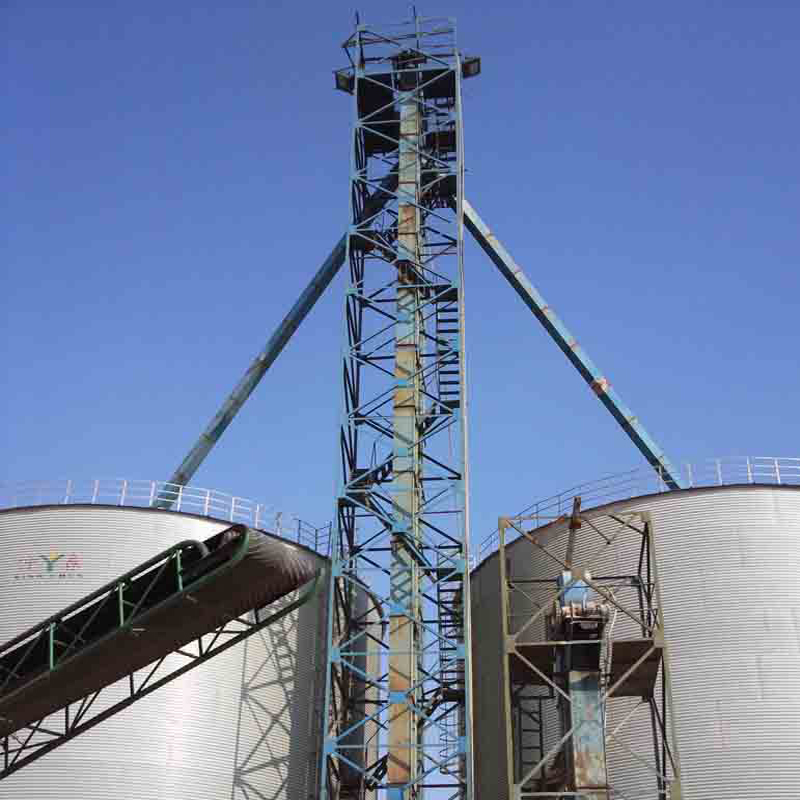
Industrial facility managers and process engineers consistently specify this equipment over alternative conveying methods for several hard-hitting commercial reasons.
The most prominent advantage is the aggressive preservation of floor space. Consider a crowded manufacturing plant: inclined belt conveyors require a massive horizontal footprint to achieve meaningful elevation, as they are limited to a 15-to-20-degree incline before material rolls back. Vertical lifters transport material at a strict 90-degree angle, requiring only a fraction of the square footage. This compact footprint is an absolute necessity in retrofitted facilities and dense storage terminals where space equals money.
Workplace safety and environmental compliance are non-negotiable in modern heavy industry. Vertical elevators feature fully enclosed, continuously welded steel casings. This weather-tight construction protects internal materials from moisture, which is vital for outdoor installations like grain silos. More importantly, the rigid enclosure contains hazardous fugitive dust, preventing it from escaping into the plant atmosphere and helping facilities meet strict OSHA, NFPA, and EPA environmental regulations.
The bulk material handling landscape is evolving rapidly. Recent industry analyses indicate a massive shift toward high-capacity, environmentally conscious vertical handling systems. As global supply chain demands intensify and environmental regulations tighten, plant managers can no longer rely on leaky, inefficient legacy equipment.
Today, the focus is on zero-emission enclosed designs and predictive maintenance. Modern vertical lifters are increasingly integrated with smart IoT sensors—such as acoustic bearing monitors and automated belt-tracking switches—that alert operators to friction or misalignment before a catastrophic failure occurs. Furthermore, industries handling highly abrasive materials like frac sand or glass cullet are demanding specialized, wear-resistant configurations that drastically reduce dust emissions while extending the Mean Time Between Failures (MTBF).
Because of their structural adaptability, these systems serve as the backbone of material handling across multiple global sectors. However, the exact mechanical configuration varies heavily based on the application.
The mining and construction materials sectors present the harshest operating conditions imaginable. Facilities must continuously elevate crushed coal, raw cement clinker, abrasive limestone, and wet gravel. Because these bulk solids are incredibly dense and highly abrasive, this sector utilizes heavy-duty, chain-driven centrifugal elevators equipped with abrasion-resistant (AR) steel buckets to withstand relentless daily wear.
In the agricultural sector, systems are primarily deployed to load massive storage silos with wheat, corn, and extruded pet food. Because food products and seed grains can be easily bruised, this industry heavily relies on continuous discharge belt models. The slower operating speed and gentle pouring action prevent the degradation of delicate pellets, ensuring maximum yield quality.
Specifying the right equipment requires precise engineering calculations, not guesswork. Over-sizing wastes capital and energy, while under-sizing causes immediate operational bottlenecks. When designing a custom bucket elevator, you must evaluate specific parameters.
The primary metric is required capacity, measured in tons per hour (TPH) or cubic meters per hour (m³/h). Total throughput is determined by three interacting variables: bucket volume, bucket spacing, and the operating speed of the traction medium. Furthermore, engineers must factor in a realistic fill rate. Buckets rarely fill to 100% capacity during high-speed operation; a fill factor of 75% to 85% is typically utilized for dry bulk materials to ensure accurate real-world throughput.
The physical properties of your bulk material dictate almost every mechanical design choice. Use this quick reference:
Bulk Density: If your material exceeds 1.5 t/m³ (like metallic ores), abandon rubber belts and specify a forged link chain to handle the immense tensile load.
Moisture Content & Flowability: Dry, free-flowing sand performs exceptionally well in standard steel buckets. Conversely, wet, sluggish clay tends to pack tightly into the bottom. To counter this, specify low-profile, bottomless buckets or utilize specialized polymer materials (like UHMW) that resist sticking.
Abrasiveness: Highly abrasive materials (like silica sand) require thicker gauge steel casings, reinforced bucket wear lips, and heavy-duty plate chains to prevent premature catastrophic failure.
Procurement teams frequently weigh traditional vertical lifts against Z-conveyors (pendulum bucket conveyors). While both utilize buckets, their mechanical applications differ significantly.
Feature | Traditional Bucket Elevator | Z-Conveyor (Pendulum Conveyor) |
|---|---|---|
Direction of Travel | Strictly vertical (or a very steep incline). | Can move horizontally, vertically, and horizontally again in a complex "Z" configuration. |
Material Transfer | Requires separate upstream and downstream conveyors. | Eliminates multiple transfer points; operates as one unbroken system. |
Handling Style | Aggressively scoops material at the boot. | Material is metered gently into upright buckets. Extremely gentle. |
Capacity & Cost | High capacity, minimal footprint, highly cost-effective. | Lower capacity limits, larger footprint, higher initial capital investment. |
If your sole objective is high-capacity vertical lifting within a tight footprint, the traditional elevator is undeniably the superior choice. However, if you are handling highly fragile consumer products (like potato chips) and need to navigate a complex plant layout without dropping the material, the higher investment of a Z-conveyor is justified.
Achieving a high return on investment relies entirely on a proactive maintenance strategy. Industrial environments subject mechanical components to constant friction and dynamic loads. Without a standardized protocol, you risk unexpected downtime and accelerated equipment degradation.
One of the most prevalent operational challenges is belt misalignment. When a belt drifts laterally away from the center of the head pulley, it scrapes against the interior steel casing. This severe friction generates heat, damages the belt edges, and creates a dangerous fire hazard. To proactively mitigate this, empirical engineering dictates the use of crowned head pulleys, which naturally guide the belt back to the center. Modern setups also utilize automated rub blocks that immediately cut power to the drive motor if lateral drift exceeds safety tolerances.
Jamming typically results from overfeeding the boot section. Preventing this requires electronically interlocking the elevator’s drive unit with upstream feeding equipment (like rotary valves) to ensure a controlled volumetric feed rate.
Daily: Monitor the drive motor for unusual vibrations or excessive heat. Inspect the boot section for material bridging or flooding.
Weekly: Check the mechanical take-up at the tail pulley. Adjust tension to prevent belt slippage or chain sagging.
Monthly: Inspect buckets for severe wear or deformation. Tighten loose elevator bolts using a calibrated torque wrench; a detached bucket will cause a catastrophic internal jam.
Quarterly: Lubricate all head and boot bearings according to greasing specifications. Inspect and replace worn shaft seals to prevent dust leakage.
Selecting the appropriate equipment goes far beyond matching capacity numbers on a generic PDF sheet. The longevity of your vertical transport system depends heavily on the engineering expertise and manufacturing quality of your supplier. You need a partner capable of solving specific material handling bottlenecks.
When evaluating your facility's needs, investing in reliable, application-specific machinery forms the foundation of operational stability. For instance, if you are processing harsh aggregates, you shouldn't settle for a standard unit; you need an environmentally-friendly sand link chain bucket elevator specifically designed to handle high abrasion while keeping silica dust strictly contained.
Always prioritize manufacturers who utilize high-grade materials, offer robust aftermarket support, and engineer systems around your material's exact bulk density and flow characteristics. If you are upgrading your facility or designing a new material handling line, reach out to the engineering experts at PK Machinery. Explore our full range of heavy-duty vertical lifting systems to secure a custom equipment quote that guarantees optimal field performance.
The maximum height depends on the structural integrity of the steel casing, the tensile strength of the lifting medium, and the available horsepower of the drive motor. Standard industrial models range from 20 to 150 feet. However, in heavy-duty applications like cement manufacturing, specialized systems utilizing steel-cable belts or heavy forged plate chains can successfully elevate materials in excess of 50 meters (164+ feet). At these heights, heavy-duty backstops are mandatory to prevent the loaded belt from reversing during a power failure.
Yes, but it requires highly specific design modifications. Standard centrifugal models are unsuitable because sticky product adheres to the bottom of the buckets, drastically reducing capacity. For these applications, engineers recommend continuous discharge elevators operating at slower speeds, utilizing bottomless buckets or buckets cast from low-friction polymers like UHMW polyethylene to ensure a clean empty.
Belt slippage at the head pulley is usually caused by insufficient tension at the boot section, an overloaded casing (jamming), or a worn-out head pulley lagging. If the tail pulley take-up mechanism is not properly adjusted, the belt loses the friction required to grip the drive pulley. Additionally, if material floods the boot section faster than the buckets can scoop it, the resulting drag can stall the belt while the drive pulley continues to spin, causing severe friction burns.
Calculating required motor horsepower (HP) involves determining the total lifting height, the maximum capacity (in pounds or kilograms per minute), and the mechanical efficiency of the drive components. A simplified field formula often used by engineers is: HP = (Capacity in lbs/min × Lift Height in feet) / 33,000. However, this base number must be multiplied by a safety and friction factor (usually 1.2 to 1.5) to account for the digging action in the boot section and gearbox inefficiencies.
While often used interchangeably, they are mechanically distinct. A bucket elevator is designed strictly for vertical transport, featuring a simple vertical loop and requiring a minimal horizontal footprint. Conversely, a bucket conveyor (Z-conveyor) can move materials horizontally, vertically, and horizontally again within a single continuous loop without transferring product between machines. Bucket conveyors keep buckets upright at all times, making them ideal for fragile materials, but they operate at lower capacities and cost significantly more.
Preventing deflagration is critical in the agriculture and chemical industries. To comply with OSHA and NFPA standards, systems handling combustible dust must utilize static-conductive and flame-retardant (SORF) belts to prevent static buildup. Furthermore, facilities must install bearing temperature sensors, belt alignment rub blocks to prevent friction sparks, and explosion venting panels on the casing to safely direct pressure outward in the event of an ignition.
Lifespan is directly proportional to material abrasiveness and maintenance frequency. In benign applications (like plastic pellets), a high-quality belt and buckets can last 7 to 10 years. However, in highly aggressive environments handling abrasive ores or hot ashes, steel chains and cast-iron buckets may experience significant wear within 2 to 3 years. Utilizing replaceable AR wear liners at the boot and discharge points is the most effective way to extend operational lifespan.
