welcome to Henan Pingyuan Mining Machinery Co., Ltd.
- All
- Product Name
- Product Keyword
- Product Model
- Product Summary
- Product Description
- Multi Field Search


Views: 0 Author: Site Editor Publish Time: 2026-09-16 Origin: Site
Selecting the wrong bucket size doesn't just reduce efficiency. It severely disrupts your daily production. Many processing plants face sudden material bottlenecks and costly equipment downtime simply because they misjudged their volumetric requirements. Finding the precise standard size for your specific material is crucial to maintaining a smooth, high-throughput operation. In this comprehensive engineering guide, we will break down exact bucket dimensions, sizing formulas, and practical selection criteria to help you optimize your bucket elevator setup.
Before diving into manufacturer catalogs, you must understand the universal language of bucket dimensions. Field engineers and facility managers utilize a standardized measurement system. This ensures complete compatibility across different casings, belts, and drive chains. Selecting the correct size requires precise knowledge of three geometric parameters.
Elevator buckets are identified by a three-number format: Length, Projection, and Depth. Grasping these dimensions is critical. It allows you to calculate actual volume and ensures the bucket clears the casing without causing friction or structural damage.
Length (L): This is the measurement across the front opening. Operators often refer to this as the "width." It dictates how much material can be scooped side-to-side.
Projection (P): The horizontal distance from the back flat wall (the mounting surface) to the furthest front lip. Projection determines how far the bucket sticks out into the casing.
Depth (D): The vertical top-to-bottom measurement of the back wall. Depth directly influences how much material is retained during vertical transit.
When reviewing bucket sizes, you must differentiate between two distinct capacity ratings. Failing to do so often results in drastically undersizing the system.
Gross Capacity refers to the total theoretical volume if the bucket were filled to the absolute brim while sitting flat on a workbench. However, a bucket in motion cannot hold this much material without spilling.
In contrast, Water-Level Capacity (usable capacity) is the actual volume retained while moving vertically. Imagine the bucket filled with liquid; the operating angle dictates how much liquid it holds before spilling over the front lip. Field calculations should always rely on water-level capacity. Generally, this is 85% to 90% of the gross capacity, depending on the specific profile design.
There is no single "one-size-fits-all" standard. Dimensions are strictly categorized by industry applications and bulk material properties. A well-engineered lift system is designed differently for lightweight, free-flowing wheat compared to dense, abrasive stone powder.
Agricultural operations handle free-flowing, relatively lightweight materials like grains, feeds, and seeds. These systems utilize high-speed centrifugal discharge designs. The buckets are molded to maximize volume while minimizing dead weight.
Common standard dimensions include:
4" x 3": Used for low-capacity seed or specialized feed operations.
6" x 4": A reliable standard for mid-sized farm setups.
9" x 6": The go-to standard for commercial grain terminals.
12" x 7": Utilized for high-throughput port facilities and large-scale processing.
Industrial facilities process dense, abrasive, or sluggish materials such as cement, aggregates, coal, and mined minerals. These systems operate at slower speeds. They rely on continuous discharge designs to prevent excessive wear and material degradation. Consequently, industrial buckets are significantly larger and fabricated from heavy-gauge steel.
Common industrial dimensions include:
10" x 5": Standard for light industrial minerals or fertilizers.
14" x 7": Frequently used in cement and aggregate processing.
16" x 8": Engineered for heavy mining and raw material intake.
24" x 12" and larger: Reserved for ultra-high-capacity mining, often custom-fabricated from thick steel plate.
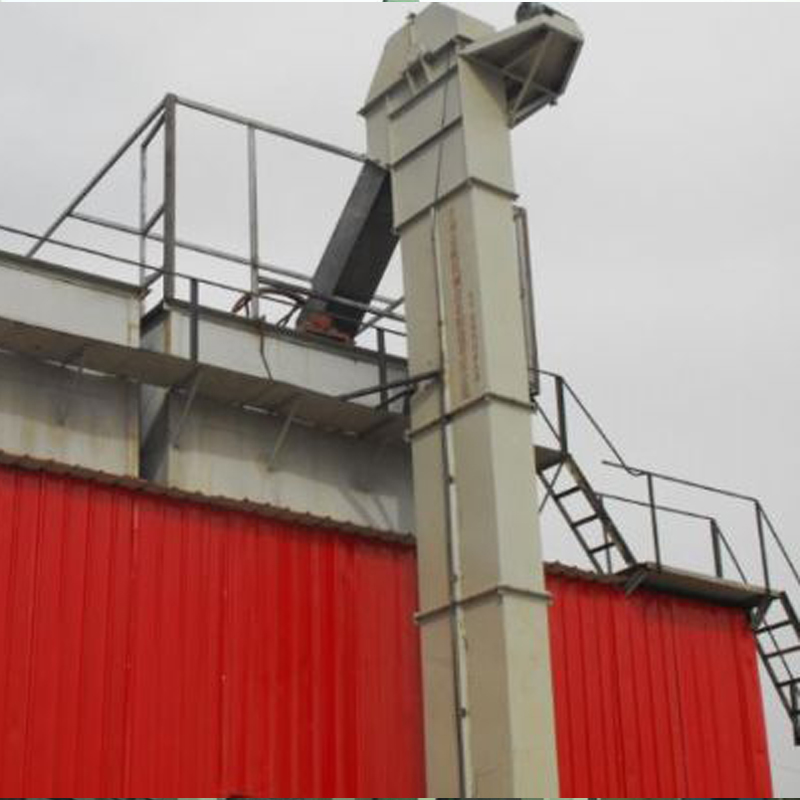
The physical size of the bucket is intrinsically linked to the operational design of the vertical lift. Furthermore, the two primary discharge methods dictate the bucket shape and how they are spaced along the traction mechanism.
Feature | Centrifugal Discharge | Continuous Discharge |
|---|---|---|
Operating Speed | High (200 - 450 FPM) | Low (100 - 250 FPM) |
Bucket Spacing | Spaced apart (Greater than projection) | Mounted flush (No gaps) |
Bucket Shape | Wider and shallower | Deeper, V-shaped profile |
Ideal Material | Free-flowing, fine to medium (grain, sand) | Sluggish, abrasive, or fragile (stone, coal) |
Centrifugal elevators rely on high speeds to literally "throw" material into the discharge chute. Because of this throwing action, buckets must be spaced further apart to prevent material from hitting the bucket ahead of it.
In contrast, continuous elevators rely entirely on gravity. With virtually no gaps between them, the back of the preceding bucket acts as a specialized chute, guiding material gently into the outlet. This allows for deeper buckets and higher volumes of dense materials without relying on aggressive throwing forces.
Selecting a size from a catalog is merely the final step. Proper sizing demands rigorous calculations based on your target throughput and the physical properties of the bulk material.
To determine the exact specifications required, engineers utilize this standard capacity formula:
Capacity (lbs/hr) = Bucket Volume (cubic inches) × Buckets per Foot × Belt/Chain Speed (FPM) × Material Bulk Density (lbs/cubic foot) / 1,728
By rearranging this formula, you can input a desired capacity (e.g., 50,000 lbs/hr) and test different standard volumes. This reveals which size achieves the target most efficiently at a safe operating speed.
Mathematical volume is only half the battle. The physical characteristics of your material heavily dictate the final equipment selection. For instance, scooping wet sand requires vastly different mechanics than moving dry oats.
Bulk Density & Abrasiveness: High-density materials demand robust traction. For example, when handling highly abrasive stone powder, a standard belt will stretch and fail prematurely. In these scenarios, upgrading to a ring chain bucket elevator is essential. These units utilize forged steel chains and deep buckets to handle extreme loads effortlessly.
Sealing Requirements: Fine powders create severe dust issues. A high-quality system must feature excellent sealing performance. Dust-tight casings prevent environmental hazards and protect internal bearings from abrasive wear.
Flowability & Moisture: Sticky materials resist discharging. If a standard deep bucket is used, wet material will pack into the bottom. Engineers must select larger, shallower buckets with wider discharge angles to ensure complete evacuation.
Once volumetric requirements are established, structural modifications will ultimately dictate your system's longevity and maintenance intervals.
Bucket construction directly impacts the dead weight on the drive system. High-Density Polyethylene (HDPE) is the standard for agricultural and food processing. It is lightweight, flexible, and significantly reduces belt wear.
Conversely, heavy-duty applications require metal. Carbon steel is highly durable for gravel and cement. Stainless steel remains the mandatory standard for corrosive environments or strict food-grade sanitation where plastics cannot be utilized.
When handling aerated or powdery materials like flour or fine stone dust, standard non-vented buckets often fail to fill completely. Trapped air creates a pneumatic barrier in the boot section.
To resolve this, buckets are modified with vent holes drilled into the bottom or sides. Venting allows trapped air to escape during filling and breaks the vacuum effect during discharge. This simple modification effectively increases the usable capacity without enlarging the equipment's footprint.
Recent industrial analyses reveal a distinct shift in vertical material handling. As global supply chains demand higher processing volumes, reliance on standard "off-the-shelf" sizes is rapidly decreasing. Today's plant managers face stricter environmental regulations and higher efficiency targets.
Specifically, there is a massive industry push toward fully enclosed, dust-tight systems. Handling hazardous or fine materials now requires advanced sealing performance to meet emission standards. Furthermore, predictive maintenance is becoming the norm. Modern facilities are integrating IoT sensors to monitor chain tension, bearing temperatures, and boot plugging in real-time. This data-driven approach allows operators to push their equipment to maximum capacity safely, minimizing unexpected downtime.
Even with precise initial calculations, changes in production rates can render an existing system obsolete. You should constantly monitor equipment for empirical signs of improper sizing.
The most common symptom of an undersized system is material backing up in the bottom casing (the boot). When you hear a rhythmic thudding or notice the motor drawing excessive amps, the buckets are likely too small for the incoming volume. This leads to "boot plugging," causing the belt or chain to slip and forcing a manual cleanout.
When handling delicate pelleted materials, excessive product degradation indicates speed or sizing issues. If buckets are too small, material overflows and falls back down the casing. Additionally, compensating for small buckets by increasing the speed creates an overly aggressive centrifugal force, shattering fragile materials against the chute.
Buckets can also be too large. Installing oversized, heavy-duty buckets for a light throughput requirement adds unnecessary dead weight. The motor draws higher amperage just to move empty buckets. Over time, this constant strain leads to premature chain stretching, bearing failure, and inflated electrical costs.
Finding the exact fit is highly specific to bulk density, lump size, and your facility's operational goals. Maximizing performance requires looking far beyond mere dimensions to evaluate chain types, sealing capabilities, and discharge methods. If you are experiencing bottlenecks or frequent maintenance issues, it is time to reassess your setup.
To accurately measure a replacement, record three primary dimensions. First, measure the length across the front opening. Second, measure the projection (the horizontal distance from the back mounting wall to the front lip). Finally, measure the depth from the top back edge down to the bottom. Manufacturers often stamp the standard dimensional size directly into the back wall for easy identification.
Capacity is dictated by bucket size, spacing, and operating speed. Small agricultural units may move a few hundred cubic feet per hour (CFH). However, heavy-duty industrial systems equipped with massive steel buckets can easily exceed 20,000 CFH. Continuous configurations generally offer the highest capacities for dense materials.
You must know your target throughput in pounds or tons per hour, and the bulk density of your material (lbs/cubic foot). By dividing your target throughput by the bulk density, you determine the required volumetric flow rate (cubic feet per hour). This number dictates the bucket size and speed required.
For highly abrasive materials like sand, glass cullet, or stone powder, heavy-gauge carbon steel or specialized wear-resistant steel (like AR400) is the standard. Nylon or polyurethane buckets can also be used for moderate abrasion, but metal is mandatory for extreme industrial wear.
Spacing depends entirely on the discharge design. For continuous systems, buckets are mounted flush against each other with no gaps. For centrifugal systems, standard spacing is typically equal to or slightly greater than the projection dimension. For example, a bucket with a 6-inch projection is usually spaced 6 to 7 inches apart.
Upgrading to larger buckets is not always safe. Larger buckets increase both material weight and dead weight. Before retrofitting, an engineer must verify that your motor horsepower, gearbox ratio, chain/belt tensile strength, and internal casing clearances can accommodate the increased load. Failure to do so can result in catastrophic motor burnout.
Ready to eliminate bottlenecks and optimize your material handling? Whether you need a standard setup or a heavy-duty system with exceptional sealing performance, expert engineering makes all the difference. Explore our complete range of bucket elevator solutions to find the exact specifications tailored to your facility's demands.
